Case Study · BioSteel Sports Nutrition · 2022–2023
Rebuilding a national fulfillment network, RFP to go-live
The problem
The network had been assembled reactively, and it showed. The incumbent network couldn't keep pace with eCommerce order volume, and outbound automation was minimal to nonexistent. Service levels were under strain. One portion of the footprint sat behind a 4PL intermediary layering a meaningful markup on the underlying providers. And nothing in the network had the headroom to absorb the growth the business was planning for.
Three problems, really: service was strained today, capacity was capped tomorrow, and the cost structure was quietly leaking margin.
The strategic call
The instinct in network design is to split by geography. I proposed splitting by order behavior instead — and won approval for it.
B2B orders are "involved" — they carry freight bookings, customer-operations touchpoints, and high scrutiny from a small number of large accounts. eCommerce orders are the opposite: configured up front, high volume, no human intervention, and unforgiving on speed. Optimizing one provider for both means compromising on both. So the network was deliberately paired: one partner built for pallets and handling, one built for eaches and automation.
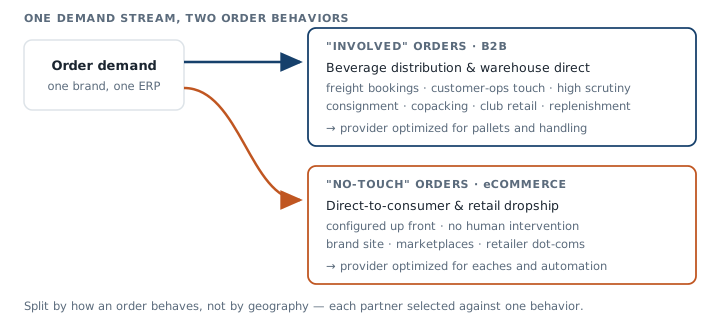
The strategic split that drove the entire network design — providers selected against behavior, not territory.
Running the RFP
I built and ran the RFP against that thesis, scoring on pricing, capability fit, footprint, and automation roadmap — then took the recommendation through to leadership signoff.
- B2B — Allen Distribution (Carlisle, Stockton, Dallas). Competitive pricing, custom packaging and kitting, an owned asset-based fleet, food-and-beverage specialization, a visible automation roadmap, and the ability to co-locate us with our parent company's distribution partner.
- eCommerce — Distribution Management (Carlisle, Dallas, St. Louis, Fresno). Two-day delivery coverage to 99% of the US population, three quality-control checks including weight verification, and a genuinely differentiated automation position — they were running 6 River Systems robotics and partnered with Shopify on robotics testing at a time when Shopify owned 6 River outright.
The capability bet paid off in a way the scorecard couldn't have predicted: the B2B partner's co-packing capability later became the production path for one of the brand's largest retail programs.
The cost model
I built the model that justified the move — old network versus new, across storage, order processing, administrative overhead, replenishment freight, final-mile freight, and inventory reduction, with scenario levers for months-of-supply policy and pallet stack height constrained by each site's square footage.
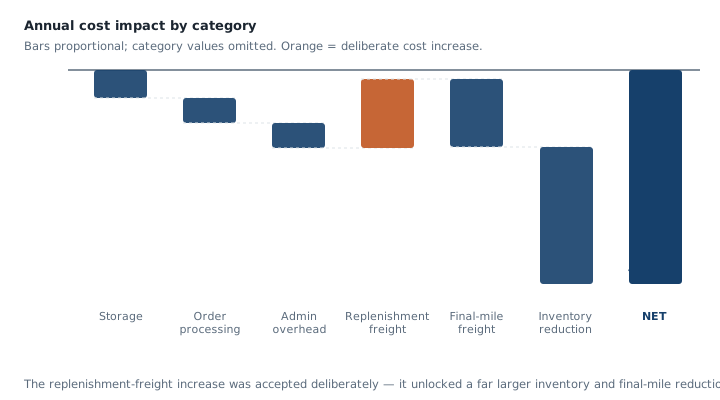
Category values omitted; bars proportional. The stated ~$1.5M is a deliberately conservative read on the model's total.
The most interesting line is the one going the wrong way. Consolidating into a tighter footprint increased inbound replenishment freight — we were moving more product further from the plants. I modeled that increase explicitly rather than burying it, because it bought a much larger reduction in final-mile freight and working inventory. Accepting a visible cost to unlock a bigger one is usually the whole game.
The transition
Two channels, two cutover strategies — for the same reason they had two providers.
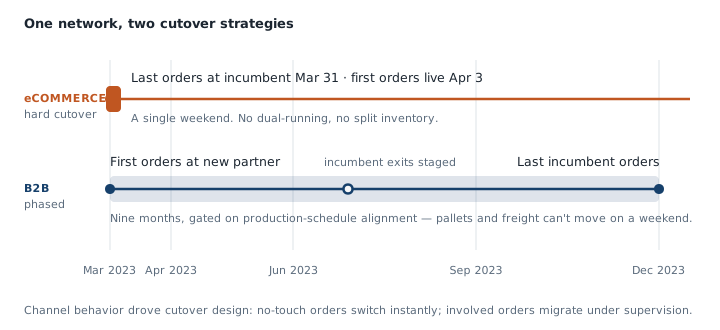
Two cutover strategies for one transition, each matched to how the channel’s orders behave.
eCommerce moved as a hard cutover: last orders at the incumbent on a Friday, first orders live at the new partner the following Monday. No dual-running, no split inventory, no customer-visible ambiguity. B2B moved as a phased transition across nine months, gated on production-schedule alignment, with incumbent exits staged individually — because pallets, freight contracts, and large-account relationships don't migrate over a weekend.
Underneath both sat the planning work: ABC-classed coverage policy, SKU-level drawdown plans at each exiting site, and a state-by-state allocation map assigning all fifty states to a destination DC in each network.
The second RFP
Midway through, a separate problem surfaced: the RTD production facility in Verona, Virginia needed dedicated warehousing. I ran a second RFP for a 5,000-pallet-position site within an hour's drive — FDA-certified and food-safe, capable of dangerous-goods handling and lot-level traceability with recall capability — including brokering an option for a 3PL to absorb the incumbent facility and its processes outright. Different problem, different clock, same quarter.
The result
- ~$1.5M in annual fixed-cost savings (conservative against the model)
- Outbound fulfillment moved from manual to automated on both sides of the network — the eCommerce partner offered effectively unbounded capacity at our scale
- Two-day delivery coverage to 99% of the US population
- A network supporting >$10M in annual revenue, delivered by a 7-person cross-functional team I led