Case Study · Confidential Engagement · Early Career
Closing a plant without dropping a shipment
The assignment
Early in my career, a publicly traded manufacturer decided to consolidate a plant into its main production site — a decision that, for sound business and market reasons, had to stay tightly held until the company chose to announce it. I was sent to the closing facility for an extended on-site assignment under strict confidentiality.
The job: document the plant's entire supply chain, build the plan to relocate all inventory, and redirect every inbound material stream to the receiving plant — executing a live consolidation while the sensitivity of the situation was preserved.
Mapping what was actually there
The first phase was documentation: every part, supplier relationship, open order, and material flow the plant depended on. A supply chain that has run for years accumulates arrangements nobody wrote down — the local vendor who just knows to show up, the informal reorder rhythm that never became a system record. Those are exactly the things that break a transfer, and the only way to find them is on site, asking.
Moving the supply base
Once the closure was announced, the inbound network had to be redirected — every supplier shipping to a facility that would soon stop existing, pointed instead at the receiving plant. Some of that was systems work. Much of it was conversations.
Suppliers had to be persuaded to stay with us at all. For those built around local delivery, the change was more than an address: one fabricator producing frames had been running a twenty-minute delivery, and would now be shipping cross-country. That converts a simple handoff into a freight and packaging problem, with damage risk on a part that had never needed protecting before. New physical requirements, new inspection expectations, and a supplier being asked to absorb all of it while deciding whether to keep the business at all.
I also built surplus safety stock ahead of the cutover. A transition with this many moving parts will have hiccups; the question is whether a hiccup stops a line. Carrying deliberate extra cover was the cheapest insurance available.
Converting the line to MRP
Then the part nobody plans for. The transferred production line ran its procurement signaling on physical kanban cards. The receiving plant ran MRP. The line had to be converted before it could be planned.
Most of that work was diagnostic. The Bills of Materials had never been structured or keyed for MRP, so component after component surfaced as unplannable — but an unplannable part looks identical whether the BOM is wrong or the planning parameters are wrong. Ruling out the second is what let me trust the first. Knowing MRP was configured correctly was the only way to prove the BOM was genuinely the problem, and then to rebuild the structures and system flags until the line could actually be planned.
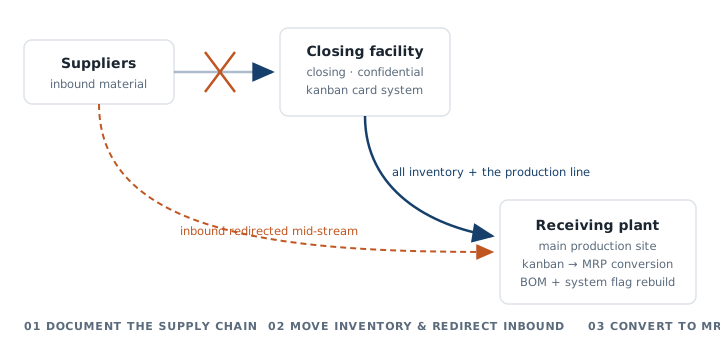
The three moving pieces: document the network, redirect it mid-stream, and convert the landing line from kanban cards to MRP.
Why it mattered
Every part of this had to work the first time. A stumble risked supplier relationships, the workforce transition, and the production line itself — and there is no rehearsal for moving a plant. It worked: the line transferred, inbound material never missed, and the conversion held.
The success of this assignment earned my promotion to senior analyst. And the details of how the confidentiality itself was managed stay exactly where they belong: offline. That's rather the point — ask me about it in an interview.